
September 28, 2026
One Step Closer to Less Waste, More Renewable Energy!

Thema Collection began with a simple idea: to create places that allow guests to experience Sri Lanka in a way that feels authentic to where they are.
From our first property, Maalu Maalu Resort & Spa on the East Coast, the collection has grown across different landscapes and communities, from the coast and tea country to wellness retreats and nature-based stays. Each property has its own character, shaped by its location, the surrounding environment and the experiences it offers.
That sense of place is an important part of what makes Thema Collection different. We do not follow one formula across our properties. Instead, each one reflects its surroundings and offers guests a different way to experience Sri Lanka. Sustainability naturally became part of this approach. When our properties are so closely connected to their surroundings, caring for those places is part of caring for the experience itself.
Across Thema Collection, this takes different forms, such as renewable energy and water conservation, waste management, biodiversity initiatives, organic farming and working with local communities. The focus is on finding practical ways to minimise our environmental impact while preserving the character of the places we operate in.
Wild Glamping Knuckles is a good example of this.
Located in the Knuckles region, the property offers a nature-based glamping experience where guests can spend time outdoors, explore the surrounding landscape and experience the quieter side of Sri Lanka. With its off-grid setting and close connection to nature, being mindful of how resources are used is an important part of everyday operations.
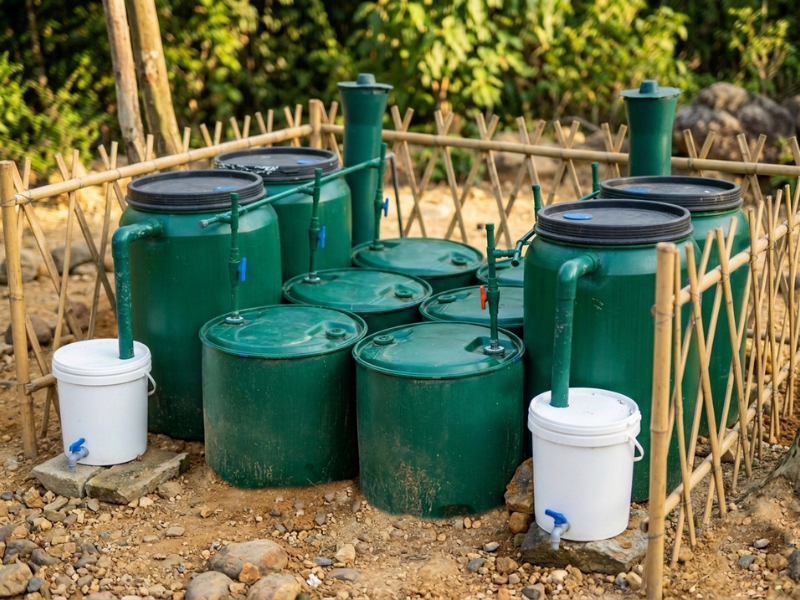
One of the things we looked at was food waste. Instead of simply removing digestible food waste from the property, we wanted to find a way to make better use of it on site. This led to the installation of a biogas facility at Wild Glamping Knuckles.
The system has two 900-litre digesters and can process around 10 kg of food waste per day. Through anaerobic digestion, the waste breaks down naturally and produces biogas, which is connected to the kitchen and can be used for cooking.
The system was sized according to the property’s actual food waste generation. An earlier proposal considered four units, but two were found to be sufficient for the property’s needs.
Based on the initial estimates, the facility could produce around 17–18 m³ of biogas each month, equivalent to approximately 7–8 kg of LPG. Actual performance will be monitored as the system continues to operate.
There is another useful outcome too. The process produces liquid bio-slurry, which can be used as an organic fertilizer for farming at the property or potentially shared with the surrounding community. The system is expected to produce approximately 15,000 liters of bio-slurry each year.
For Wild Glamping Knuckles, it is another practical way of making better use of resources within a setting where nature is such an important part of the experience.
It is also a reminder that sustainability does not have to look the same everywhere. At each Thema Collection property, it starts with understanding the place and finding ways to operate more responsibly within it.
Blog
Related Articles