October 28, 2026
Ritigala Monastery: Sri Lanka’s Mountain of Medicinal Plants

On the eastern slope of a mountain in northern Sri Lanka, a stone pavement climbs through forest to the ruins of a monastery: about fifty stone double platforms, an ancient reservoir, and the remains of what is interpreted as a hospital. The Ritigala monastery stands in a strict nature reserve where, according to UNESCO’s tentative list entry, 176 of the recorded plant species, 40%, are listed as medicinal plants.
| Ritigala at a glance | Detail |
| Reserve status | Strict Nature Reserve since 7 November 1941 |
| Area | 1,528 hectares |
| Height | 766 metres, about 600 metres above the plains |
| Monastery ruins | About 24 hectares |
| Peak rainfall | Northeast monsoon, December to February, up to about 125cm |
| Medicinal plants | 176 species, 40% of those recorded (UNESCO tentative list) |
| Access | A defined path, with a guide and a ticket |
A Wet Mountain in a Dry Zone
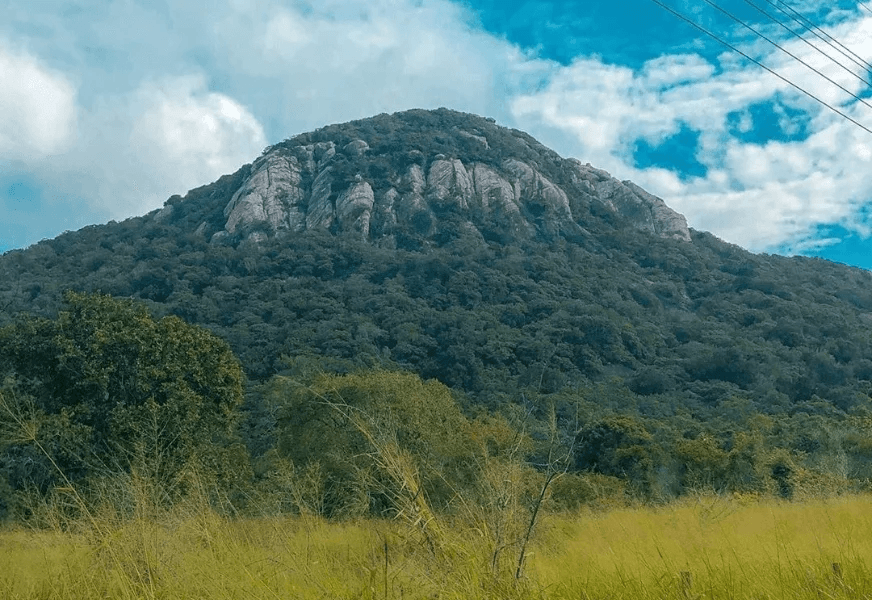
Ritigala rises steeply from the plain of the north-central dry zone. It has four peaks and runs 6.5 kilometres, and its highest point, Ritigala Kanda, stands at 766 metres. The Mahavamsa knows it as Ariṭṭha Pabbata, the Dreadful Mountain.
The height catches moist winds, so the mountain gets more rain than the lowlands around it. During the northeast monsoon, from December to February, it receives the highest rainfall of the entire dry zone, about 125 centimetres. Mist and cloud cover the summit in the southwest monsoon season, when the plains below are in drought. The north-central plains were known as Wewu Bandi Rata, the land of rainwater reservoirs, and Ritigala’s wet microclimate is a singular exception there.
That wetter, cooler summit supports a forest unlike the scrub around it. Dry mixed evergreen forest covers about 65% of the reserve, with a closed canopy up to 30 metres high. Along the ridge-tops, where humidity and condensation are highest, a short-stature forest has a canopy of only 2 to 3 metres. UNESCO’s entry counts six micro-endemic species, found nowhere else, and the Department of Wildlife Conservation records an endemic gecko, the Ritigala day gecko. A Department leaflet lists more than 30 mammal species, among them the endemic golden palm civet and the toque macaque.
Inside the Ritigala Monastery
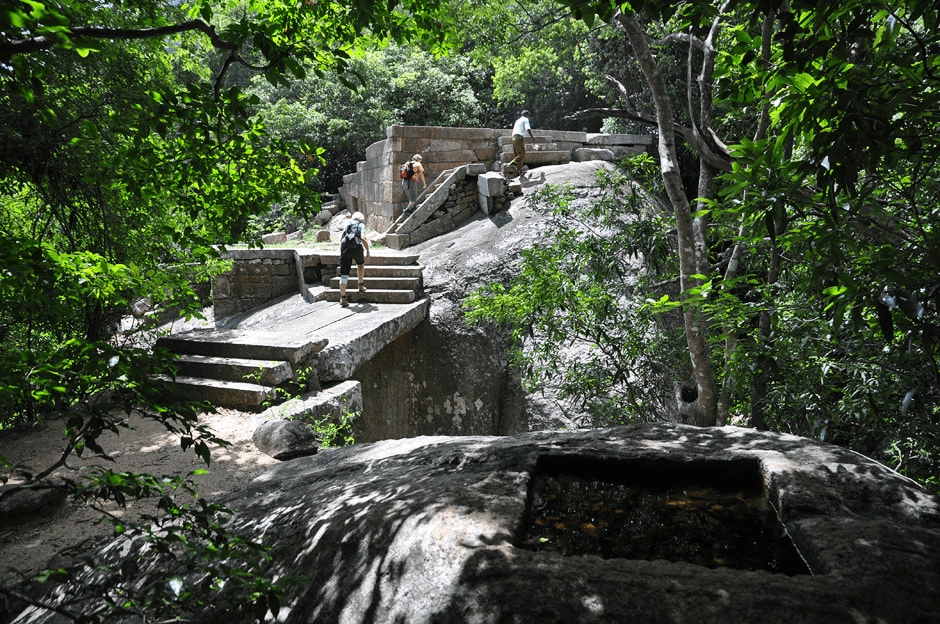
The monastery precinct begins at the Department of Archaeology’s office near Banda Pokuna, an ancient man-made reservoir with a polygonal bund 366 metres around. Its construction is credited to King Pandukabhaya, and it probably served for ritual bathing before visitors entered the monastery.
From there a stone pavement 1.5 metres wide, laid with interlocking slabs of hewn stone, climbs through the forest. Three large circular platforms along the way give places to rest. The ruins cover about 24 hectares, with roughly fifty stone double platforms: paired raised platforms joined by a stone bridge and set exactly east to west. They are believed to have been used for solitary practice such as meditation, and for teaching and ceremony.
Ritigala has none of the usual icons of a Buddhist temple. There are no stupas and no bo tree, and the only Buddha images are a few broken granite statues in caves. The only representational carving at the site is on decorated urinal stones. The monks who lived here were Pansukulika, ascetics who wore robes made from discarded cloth. Inscriptions at the site date to the 1st century BCE, and in the ninth century King Sena I endowed a larger complex higher up the slope for them.
The Medicinal Mountain
UNESCO’s tentative list entry describes about 441 species of flowering plants on Ritigala. It says that, of the recorded plant species, 176, or 40%, are listed as medicinal plants, citing a 1996 survey. Legend explains the reputation in its own way. In the Ramayana, Hanuman carried a mountain of medicinal herbs from the Himalayas and dropped a fragment of it at Ritigala. A herb called Sansevi, near the crest, is said in local tradition to confer long life.
The ruins carry their own evidence. Beyond a stone bridge lie the remains of what is interpreted as a monastery hospital, with grinding stones and large stone-cut basins that fit the preparation of herbal oils and compounds. Ayurveda, the traditional system of medicine practised in Sri Lanka, works with plant-based preparations of exactly this kind, which is why the mountain is a natural stop for anyone interested in its roots. The ruins show how the monks may have used the plants.
Walking to the Ruins
Entering the strict nature reserve itself is prohibited without the permission of the Director General of the Department of Wildlife Conservation. The monastery is visited along a defined path, with a ticket and a local guide. The path is not technically demanding, but it can be slippery after rain, and the rainfall peaks from December to February. Good walking shoes and light clothes suit the climb, and a visit takes about three hours. The site lies about 43 kilometres from Anuradhapura.
Along the path, the features come in this order:
- Banda Pokuna, the ritual-bathing reservoir at the foot of the precinct.
- Steep steps up to the stone pavement, which climbs through the forest.
- The first double platforms and the stone bridge.
- The monastery hospital ruins, with grinding stones and oil basins.
- A side path to a lookout above a stream, then an artificial waterfall made by setting a stone slab between two rocks.
- About 500 metres further, two sunken courtyards, each with a large double platform. One is among the largest stone structures in the monastery.
- The path ends in the forest at the edge of the reserve.
Ritigala and Ayurvie Sigiriya
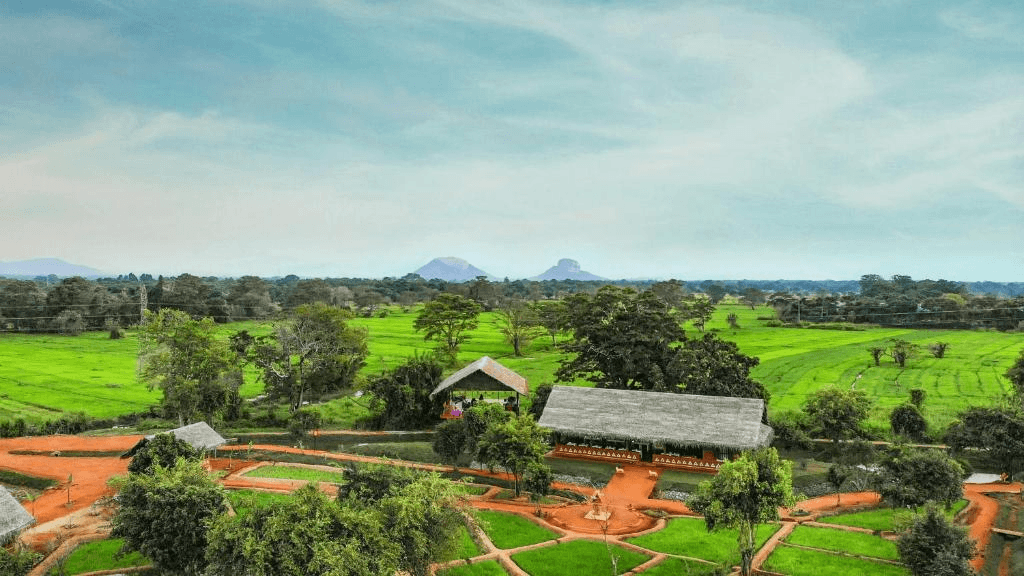
The Ritigala monastery sits among medicinal plants, and its ruins include what is interpreted as a hospital. Together they show how long plant-based medicine has been part of life in Sri Lanka. Ayurveda still works with plants today, and we work within that tradition at Ayurvie Sigiriya, an Ayurveda retreat in Sri Lanka in Audangawa, in the Cultural Triangle. An organic garden supplies our vegetables and herbs, and guests can walk it with a doctor or chef and see herbal teas and oils prepared.
We run doctor-led Ayurveda programmes, and each stay begins with a consultation that shapes a personalised plan. Our villas overlook paddy fields and are built from recycled polypropylene bags filled with subsoil in place of bricks and cement. Our meals are vegetarian and prepared to suit each guest’s dosha, with daily yoga.
For guests who want to see the mountain for themselves, we arrange a visit to Ritigala. It takes about 3 hours, is rated Easy, and starts at 9.00am from the hotel, with tickets, our hotel naturalist, a local guide, and a snack included.
Explore our accommodation and current offers, or contact us for help planning your stay. Ritigala is one place where that tradition’s history can be seen, and Ayurvie Sigiriya is where we practise it today.
Blog
Related Articles